
The purpose of art is to lay bare the questions that have been hidden by the answers. –James Baldwin
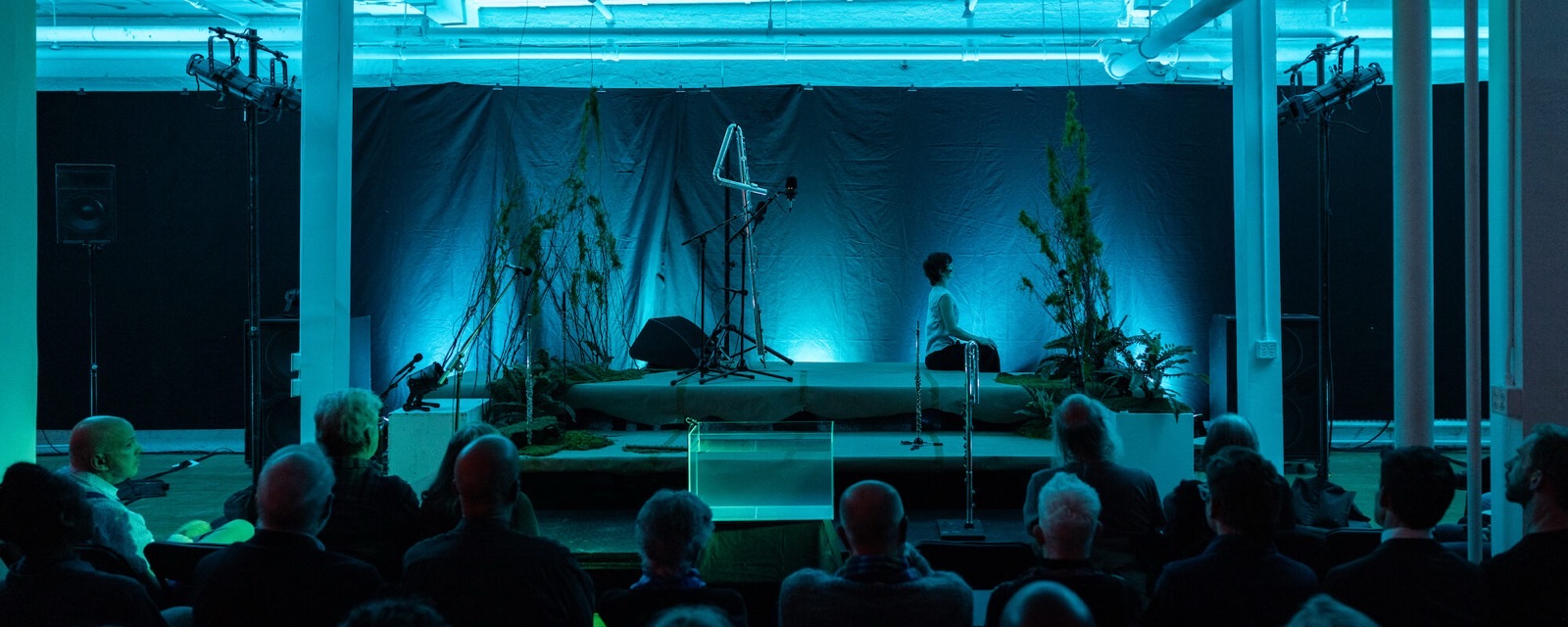
Claire Chase, the MacArthur Fellow and flutist who is one of contemporary music’s most significant figures, has built a career on relentlessly commissioning new works to expand her instrument’s repertoire. This mission is crystallized in her landmark 23-year commissioning initiative, Density 2036. The latest and perhaps most ambitious commission in that series is Elwha!, a full-evening “three-way collaboration” with the legendary sound artist Annea Lockwood and the Elwha River in Washington’s Olympic National Forest.
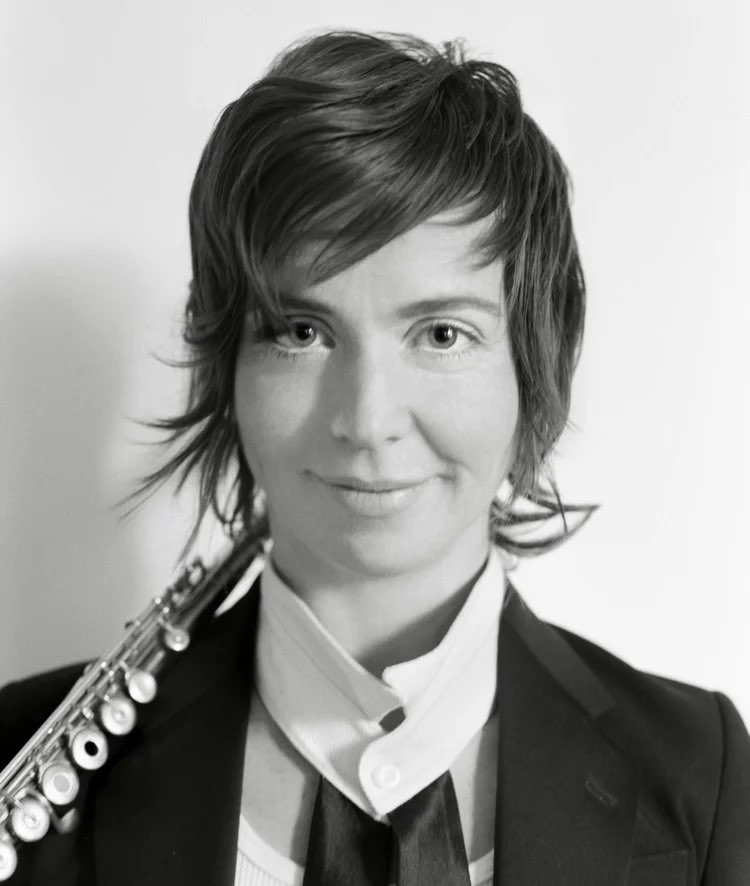
Chase reinforces this work through a deep commitment to education. She actively mentors, formally and informally, people who are wrestling with these types of questions. She is a deeply committed educator: a professor of the practice at Harvard University, a creative associate at The Juilliard School, and flute tutor at the Darmstadt International Summer Courses, in addition to leading workshops internationally. In this masterclass on improvisation, you can see an example of her teaching style.
When we spoke, she had just returned from an intense, 15-day workshop in Germany. “It’s so beautiful to see how bright the musical future is in the hands of this upcoming generation,” she shared, her “heart and spirit rejuvenated.” This sense of invigoration, even in what we both agreed are “challenging” and “terrifying” times, created the perfect opportunity for a deeper conversation.
Thematic Origins: Listening as a Life Practice
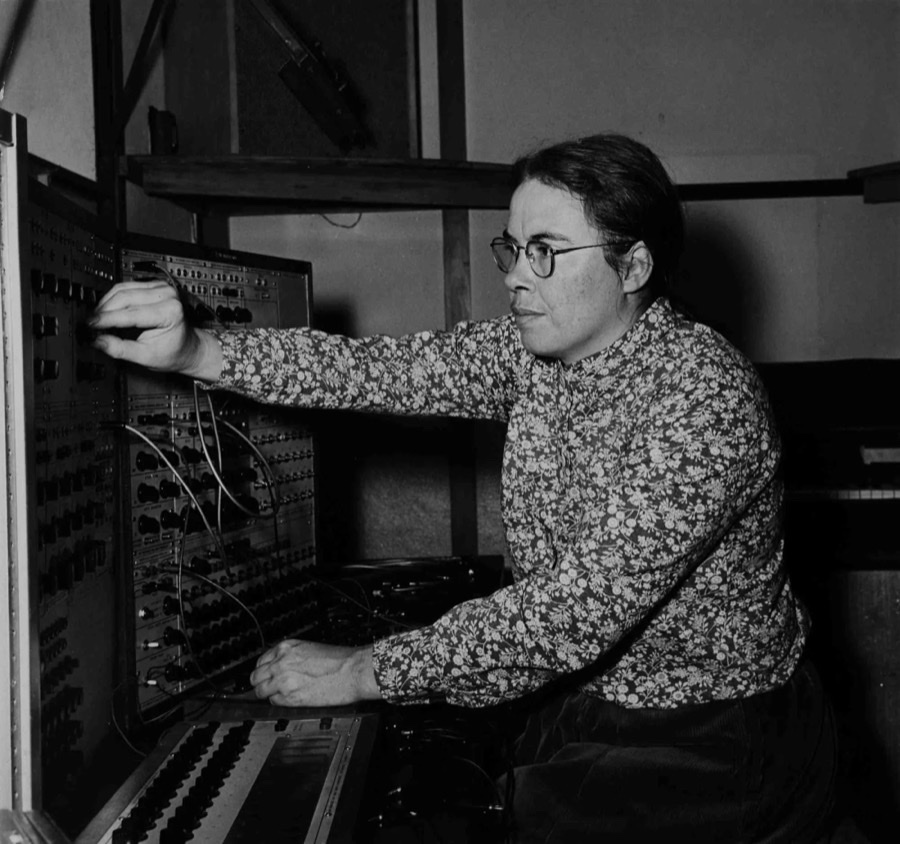
Our conversation began, naturally, with the foundational influence of composer Pauline Oliveros, the pioneer of “Deep Listening.” This was a fortuitous connection, as it’s a topic I’ve been exploring in a series of articles on listening for Flutist Quarterly—the third of which appears in this issue. I asked Chase about the Oliveros concepts and their influence on her work.
“Pauline’s maxim was that how we listen creates our life,” Chase said. “As an invitation for music making, and also for world-building, for family-building, for community-building, I can’t think of a more powerful or more direct invitation to live more fully, more purposefully. The invitation is ever more necessary and urgent in these times, because how we listen really does create our life. It creates our culture. It creates the quality of the work, the quality of the activism, the quality of the community cultivation that we’re able to do. It sounds like such a simple invitation yet it is so complex and so multi-layered. I continue to learn from Pauline’s teachings every day.”
She noted the resurgence of Oliveros’s work in difficult times. “There’s a reason that so many people turned to the work of Pauline in the pandemic when we were all tremendously isolated and confused and terrified, and there’s a reason a lot of people are turning to her work in this geopolitical moment too.”
The connection, I learned, is also deeply personal. “She was, on a personal note, one of my earliest and closest mentors,” Chase recalled. “She’s kind of an angel in my life. I met her when I was very young and then I reconnected with her when I was at Oberlin. She was really the first person who took my idea seriously to create a new kind of ensemble.”
“Pauline was the very first person to say, ‘I think this is a sterling idea and I think you shouldn’t wait to get it started. And I’m willing to be the first person on your advisory board.’ And I looked at her and nodded gratefully. And then I went back and I looked up ‘What’s an advisory board?’ I didn’t know anything.” Chase smiled. “She has been there for me at just about every critical juncture of my life, the difficult moments and the wonderful ones. I was fully supported to be who I was and wanted to be, and that kind of mentorship is something I take very seriously. As the recipient of that gift from Pauline, I feel such a deep responsibility to offer that same kind of mentorship to the next generation of players and also organization builders—I want to work with musicians and with young people who are building the emergent arts models of the 21st century, models that are going to look very different from the ones that folks in my and previous generations built.”
A Three-Way Collaboration: The Elwha River Project
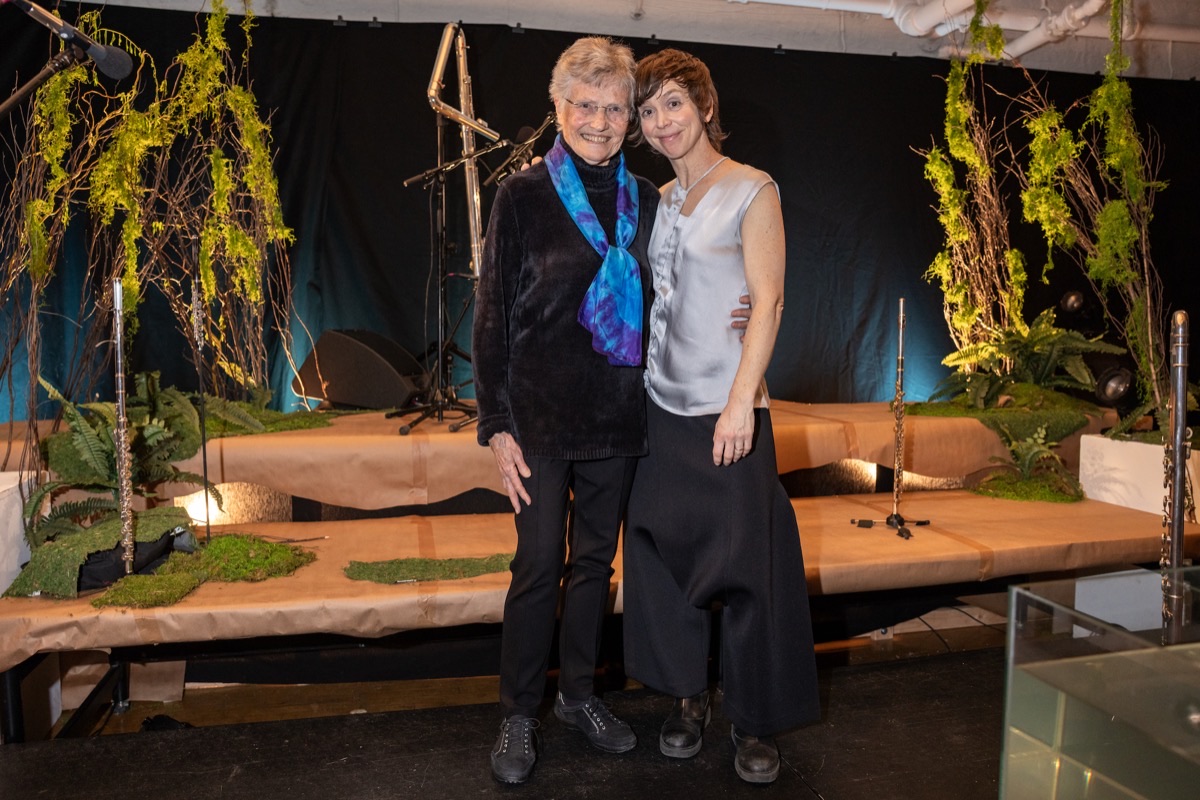
This philosophy of deep, active listening flows directly into her monumental new project, a collaboration with the legendary composer Annea Lockwood—a good friend of Oliveros.
“Yes, Annea Lockwood,” Chase said. “She just turned 86 this year, an absolutely extraordinary force of nature. The piece is called Elwha!, named after a river in the Olympic National Forest.” She explained it is the site of one of the largest ecosystem restoration projects in National Parks’ history and “a rare environmental success story, though there are of course some very real challenges that are still being faced by the river and its protectors and advocates. But the arc of its history is bending toward justice, renewal, and resilience.”
After dam removal, “the restoration process has taken off, and the salmon population has returned in record numbers. It is a story we are really excited to tell through sound.”
“Annea and I are really thinking about the project as a three-way collaboration between the two of us and the river,” she continued. “And the river is not just subject material. The river is absolutely a co-creator. We are using about a year and a half’s worth of recordings that Annea and I have done on site, with her wonderful hydrophone microphones.”
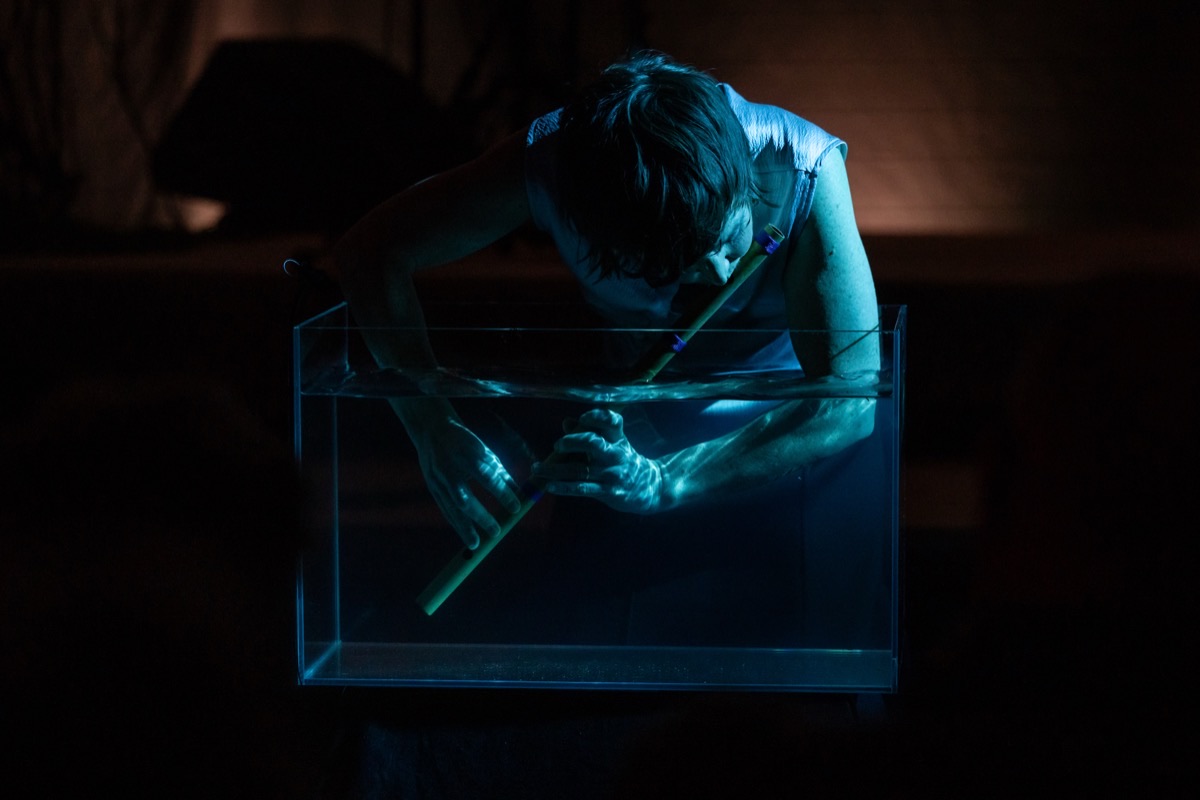
When I asked if she meant recording in the river, she confirmed. “We’re recording the river. Yes. Some are of the river’s surface. Some of them, microphones actually go in the water. And we’re doing some deep underwater recording as well. “What I can tell you about the music that this river contains is that it’s absolutely astonishing in its rhythmic, motivic, melodic, harmonic, and gestural material. There is so much music in this body of water. It is absolutely alive.”
That last line—”It is absolutely alive”—was the perfect opening to discuss the growing global movement to grant legal “personhood” to natural entities. It’s a movement that has seen the Whanganui River in New Zealand granted its own legal standing. Since then, dozens of communities in at least eight U.S. states—Pennsylvania, Ohio, New Mexico, New York, Maryland, New Hampshire, California, and Maine—have passed local laws codifying nature’s rights and are being pursued by Indigenous activists in Latin America. At this point I couldn’t help but comment that I would personally give rivers personhood before I would do so for corporations. Chase’s response was “Oh my goodness, yes!” While the Elwha doesn’t have personhood yet, Chase and Lockwood are, as she put it, “absolutely interacting with the river as if it already does have this agency and autonomy as a living, breathing being.”
“The musical material of this river is just staggering,” she added. “I’ve spent so much time just listening to and transcribing the harmonic content, the rhythmic content.”
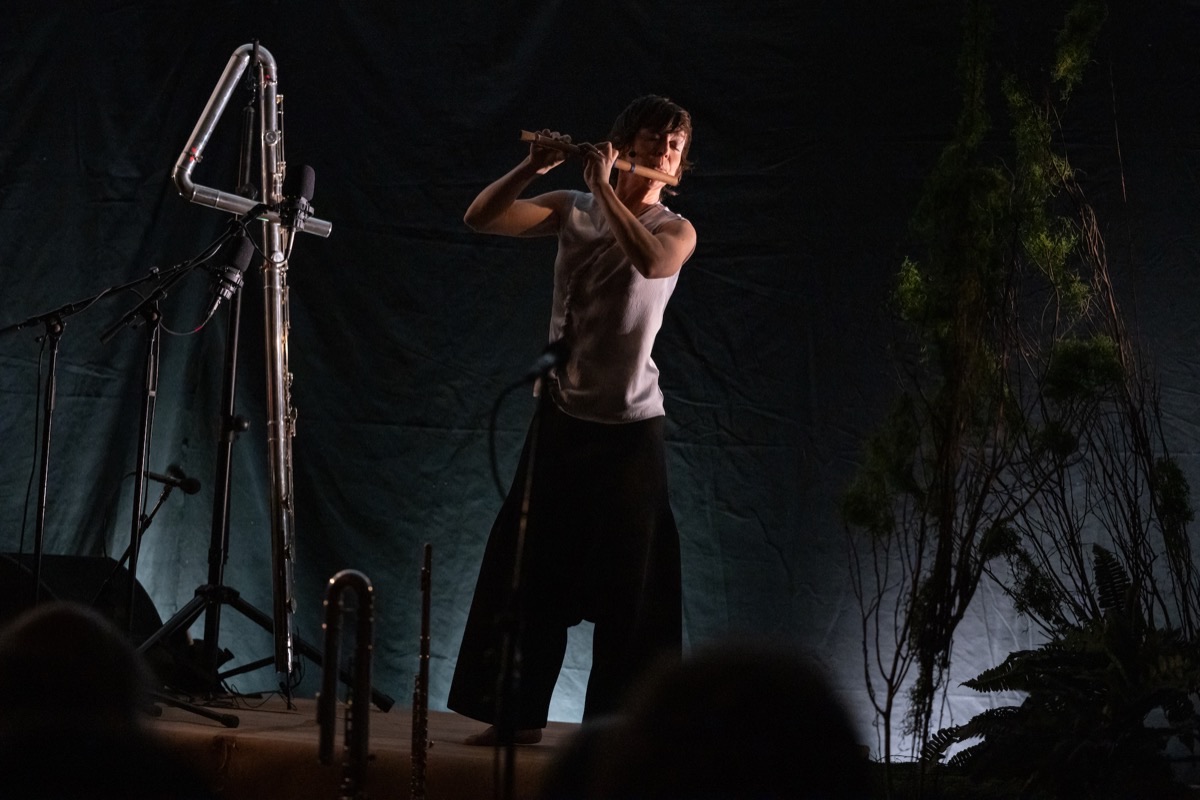
The instrumentation for this collaboration is, fittingly, unconventional. “We decided to make the piece for seven flutes… of various varieties,” Chase explained. “I’m working with these bamboo water flutes that change pitch as you dip them into bodies of water. I’ve been recording in a bathtub.” She is also using glissando flutes and is “working on a section right now involving seven contrabass flutes. So it’s gonna be wild.” The initial version will be for one live flute, six pre-recorded, and “7.1 truly immersive sound.”
The process is as collaborative as the concept. “Annea told me from the beginning, ‘Claire, I’m not writing this piece for you. We’re making this piece together.’ And that’s been such an education.” This “maximally inclusive” process, she said, involves “transcription, improvisation, transcription of improvisation, composition in the traditional sense, all kinds of oral traditions.” The goal is to treat “notation on the page as just one form of notation,” understanding that many “ancient and powerful forms” are embodied and contained in oral traditions, “looking at those practices on a continuum. Annea has such a phenomenally creative and open mind. Her imagination is vast and hugely inspiring.”
I remarked that the whole project—honoring the environment, the collaborative process, the deep listening—felt “so Pauline.”
“Yeah. Yeah,” she laughed. “She’s pulling the puppet strings.”
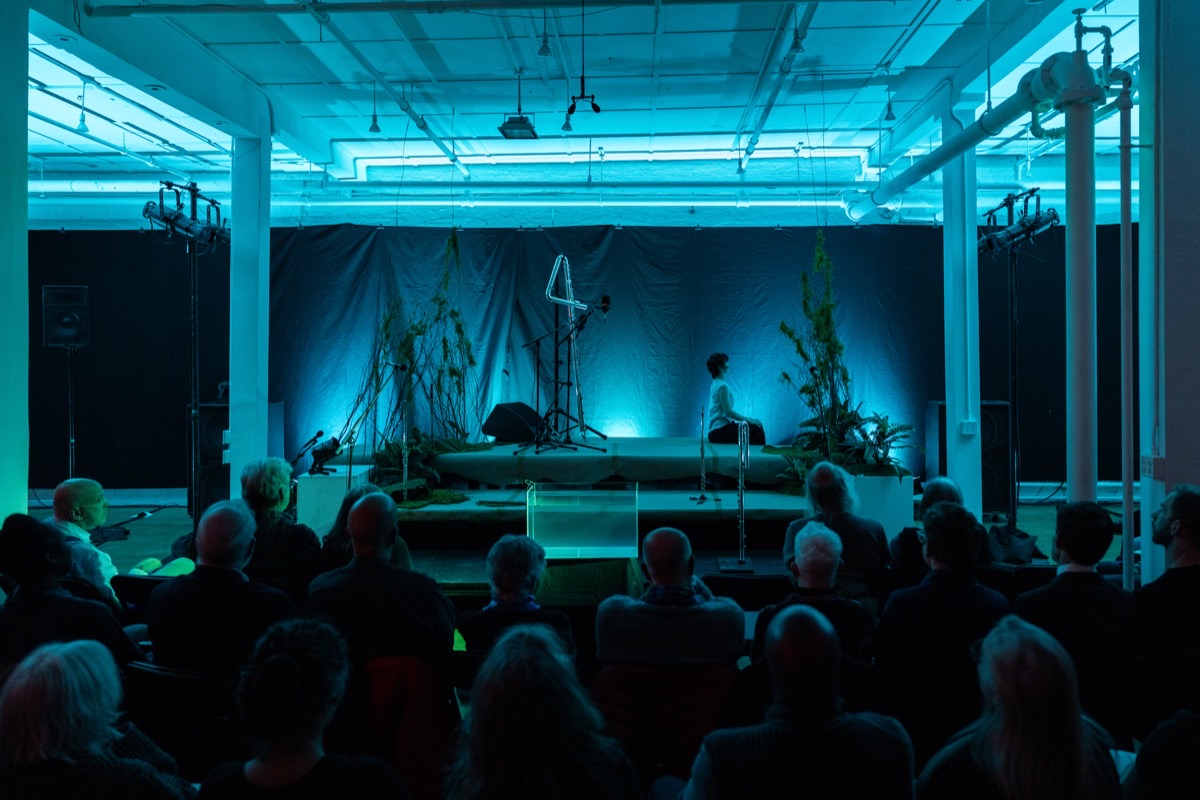
By the time this article reaches print the premiere of Elwha!, 2025’s addition to the Density 2036 project, will have occurred on December 11 and 12 at The Kitchen in New York City. Density 2036 is Chase’s landmark 24-year initiative to commission an entirely new body of repertoire for the flute. The project, which takes its name from Edgard Varèse’s seminal 1936 solo, Density 21.5, is set to conclude on the piece’s hundredth anniversary.
Building New Models: From the International Contemporary Ensemble to Emergent Futures
From collaborating with a river, our conversation shifted to collaborating with people, and the artist-driven organizational model she pioneered with the International Contemporary Ensemble. I asked her how that model has evolved and what the path forward is for young people today.
“I co-founded the group when I was still an undergraduate at Oberlin and ran it for about 17 years,” she said. “It was my life and it was a labor of love and I cherish every day that I got to spend building that crazy thing. It was also time for me after 17 years to pass it on. So I can’t really speak for the organization in its current form because I’m not involved. I think that’s the healthy thing for a founder to do.”
“But what I can tell you,” she continued, “is that the artist-driven organizational model, at least for the first 15 years, was so essential, not just to our identity, but to the process. Creating the work that we created, the educational programs, it wasn’t just lip service that idea—it was a mode of making, a mode of being, and we took that process to an extreme. I was both the executive and the artistic director and, for a long time, the rest of the staff was also made up of players from the ensemble. So the band was deeply involved in every organizational and executive decision. It’s a pretty radical model, designed to produce radical work and I am tremendously proud of the body of work that we were able to create.”
When I pressed her on what the “radical model” for today might be, she demurred. “The group now is very different from the group that I started. I think that as the organization has grown and matured, the artist-driven nature of its operational model has had to change. I think it’s hubristic for me, or anybody like me, who has founded an organization more than 20 years ago to say to an emergent generation: ‘This is the way you should do it.’ What I am convinced of is that we absolutely need multiple perspectives. I think we need more spaces for these conversations and also for incubating organizational models. I would love to see institutions make the space, resources and also brain power available for the next generation. The great choreographer Liz Lerman always says, ‘Ask a big enough question, you need more than one discipline to answer it.’”
Chase suggested that the key person grappling with these questions now is the ensemble’s current artistic director, George Lewis, the influential composer and scholar of the Association for the Advancement of Creative Musicians (AACM).
The Expanded Voice: Mentorship and Musical Ecosystems
This belief in intergenerational dialogue is central to Chase’s work as an educator and her vision for the Density 2036 project. She seems to combine a “how-is-this-going-to-work-by-next-Thursday” scrappiness with a “big dreamer” mindset.
“I am very practical,” she confirmed. “I like to work with young people, talk specifically about the practicalities, the realities. And I’m also a dreamer. I believe that a marriage of practicality can and absolutely should be combined with a big dreamer mindset: idealism and optimism and audacity.”
When I asked what she plans to do after the project concludes in 2036, her answer was characteristically forward-looking. “I hope to be redirecting my energy toward supporting projects that are designed by the upcoming generation. And I’m already doing this with the Density Fellows program. The point of that program is not to have people take my versions and try to replicate them. It’s the opposite: to support and refine and deepen their vision. The classical music model really doesn’t work with music that’s developed in this way. What I try to do with each of the fellows is to support their approaches to these projects. In many cases the pieces are unrecognizable from my original versions of them, and that’s so exciting to me. That is a sign of the health of the artistic process.”
Her goal is to create an ecosystem. “I love thinking about these systems or processes as ecosystems. The ideal way that a piece grows, it’s like a tree, right? The branches flower and the air is purified and it becomes a home for creatures and other species. But, importantly, there’s all this work going on that is felt but not seen. It’s underground. It’s about root systems and it’s about community building. About generosity. But these root systems need our care.” To that end, she’s building an interactive map on the Density website. It’s a “community-controlled resource,” she explained, for musicians to register their own performances of the pieces. “I love to imagine in 20, 30, 50 years what this kind of ethnography of each piece would look like. We don’t really have a mechanism for this and publishing companies don’t do this for us.”
Chase goes on to explain that current systems are not set up to facilitate sharing resources and because of this we don’t actually know what the development and the trajectory becomes in the hands of different performers in different areas of the world. “And we should absolutely know what that is. Wouldn’t it be rich to have that information? Just create a living archive as we go. I hope in 2036 to have a lot more time to think about these things. And also to support, amplify, and help resource all these other ideas, whatever that would be.”
Coda: The Big Picture (and Big Bertha)
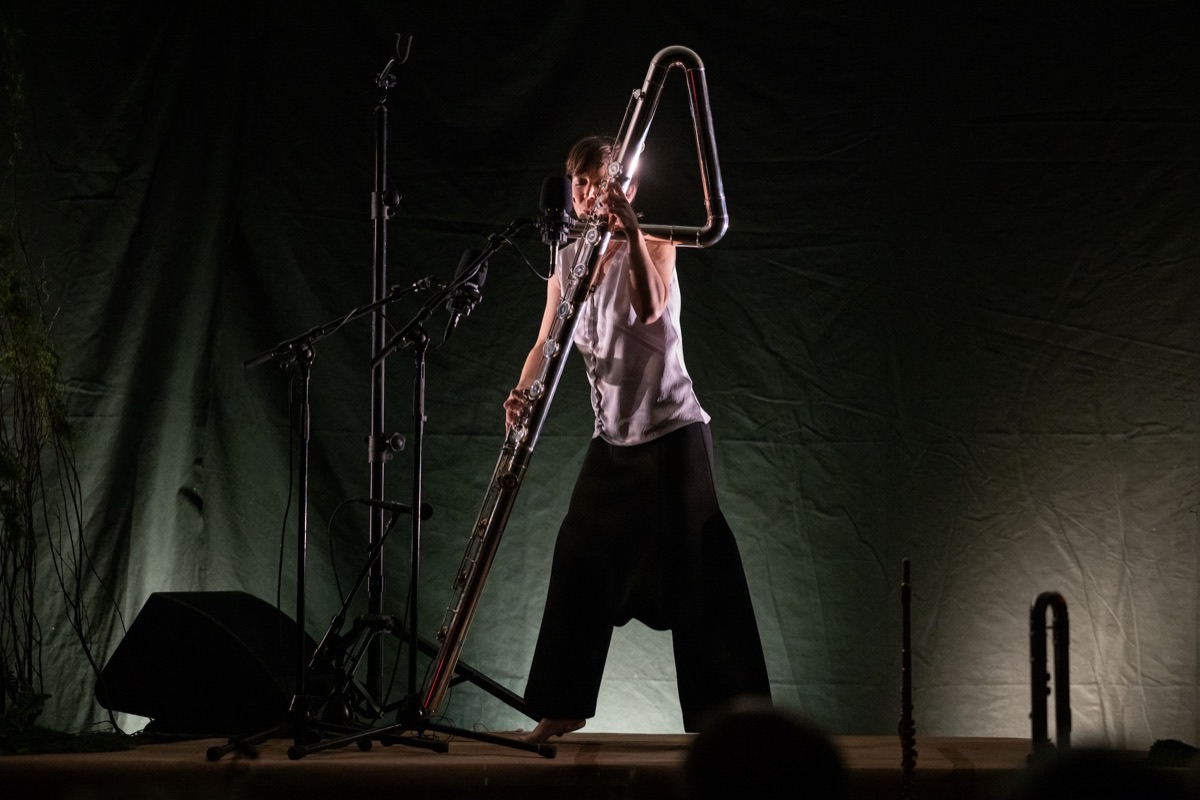
As our conversation concluded, I was struck by the profound coherence of her vision. “We covered a lot of essential things for me,” she summarized. “Pauline. Deep listening ecosystems, liberated rivers, trees, root systems, young people, emergent models. These are the things that are most important to me. And I love the flute!” She recently put these very ideas into practice as the music director of the Ojai Music Festival, which she programmed explicitly around these themes of community, listening, and healthy artistic ecosystems.
I ended with a lighter question: Imagine that her contrabass flute, Big Bertha, writes a Dada manifesto. What are its three most incomprehensible demands? And does one involve a revolt against the tyranny of straight lines?
Chase laughed. “I love it. I love it. I feel like Big Bertha—the most important things for her are her attitude and her persona. She’s got a whole being, a fabulous, grouchy persona…her own cave. Stagehands recently told me, ‘Oh yeah. Bertha just hasn’t had her cigarette and her whiskey yet today.’ That’s totally her. Every stage hand, every concert presenter, every collaborator, every listener immediately understands that this is Big Bertha.”
That image—of an instrument with its own stubborn, soulful personality—feels like a perfect metaphor for Claire Chase herself. Her work is deeply serious, intellectually rigorous, and aimed at tackling the most profound questions of our time. Yet it is also infused with a sense of joy, audacity, and a collaborative spirit that invites everyone—and everything, from rivers to fellow musicians—into the conversation. The flute is her voice, but as our conversation made clear, she uses it to help us all listen more deeply to the world.