


In the grand narrative of the flute’s evolution, the 19th century is often presented as a linear march toward the inevitable victory of Theobald Boehm. We are told a story of primitive woodwinds giving way to the logic of the cylinder bore and the parabolic headjoint. But history, when viewed through the lens of the archives, is rarely a clean line. It is a fractious, messy, and often bitter “Battle of the Systems,” a war fought in patent offices, workshops, and the letters pages of musical journals.
Casualties in this war were high. For every Boehm who secured his legacy, there were dozens of innovators whose distinct visions were relegated to the scrapheap of “eccentricity.” Among these forgotten masters, none is more fascinating, more skilled, and perhaps more tragic than Cornelius Ward.
To dismiss Ward as merely a failed competitor to Boehm is to misunderstand the scope of his genius. Ward was not a mere tinkerer; he was a polymath of instrument design whose obsession with mechanical logic bordered on the pathological. He revolutionized the drum, collaborated on the modern bassoon, improved the clarinet, and produced flutes of such exquisite craftsmanship that they remain to this day marvels of the jeweler’s art.
A closer look at the Dayton C. Miller Collection at the Library of Congress allows us to rescue Cornelius Ward from the footnotes. It reveals a man who arguably understood the mechanics of music better than anyone in Victorian London—but who perhaps understood the human hand least of all.
The Craftsman’s Roots: Steel and Precision
To understand the peculiar intensity of Ward’s flutes, one must look at his origins. Unlike many luthier-style makers who came from wood-turning backgrounds, Ward was born into a world of precision metal. Census and genealogical records indicate he was born in Stepney, Middlesex, on January 24, 1796, the son of John Ward.[1]Readers: Fascinatingly, we couldn’t find an image of him. Do you know of one, or have access to any sites behind paywalls that might have one? If you find something, please send it our way!
Crucially, John Ward was not a musician; he was a gunmaker and toolmaker. This distinction is vital. A gunmaker does not tolerate slop in a mechanism; a toolmaker understands the tempering of steel and the precise interplay of moving parts. This metallurgical DNA is evident in every instrument Cornelius would later touch. While his contemporaries were often struggling with soft brass keys and unreliable springs, Ward was thinking in terms of industrial tension and hardened steel.
He cut his teeth in the flute world as a “ghost maker”—the anonymous craftsman behind a famous name. Doctoral research suggests that when the celebrated virtuoso Louis Drouët set up his flutemaking business at 23 Conduit Street, London, around 1818, the hands that actually filed the keys and turned the wood belonged to Cornelius Ward.
Drouët was known as the “Paganini of the Flute,” a player of dazzling technique and high fashion. For Ward to be entrusted with the manufacture of the “Drouët Flute” speaks volumes about his early reputation. Instruments stamped “L. Drouet” from this period are characterized by their small embouchures and specific bore dimensions, but the workmanship is pure Ward. This apprenticeship served as a masterclass in the “old system,” but Ward’s restless, gunmaker’s mind was already looking for problems to solve.
The Miller Connection: Collecting the “Dead Ends”
The Dayton C. Miller Collection holds the physical evidence of Ward’s evolution from a ghostmaker to a radical innovator. The collection includes several prime examples of his work, specifically DCM 0044, DCM 0572, DCM 1137, and DCM 1260.
But why did Dayton C. Miller—a physicist focused on acoustic perfection—collect the instruments of a “failed” 19th-century inventor?
Miller did not acquire these instruments by accident. Records indicate that he actively sought them out through his network of European dealers, specifically buying DCM 1137 from the British collector John T. Shiel in April 1932. For Miller, Ward’s instruments were vital scientific data points. As the translator of Theobald Boehm’s writings, Miller was fascinated by the “Battle of the Systems.” To write an accurate history of the flute, he needed physical proof of the opposition.
He collected Ward’s flutes precisely because they represented a divergence in evolutionary theory. Miller was obsessed with acoustic logic, and in Ward he found a kindred spirit—an inventor who, like Miller, believed that science could solve musical problems. Miller was particularly fascinated by Ward’s attempts to solve the problem of “air cavities” in the headjoint (seen in DCM 0044). Miller was, after all, a physicist first. He had spent decades studying bore perturbation—the way internal irregularities affect sound waves—and visualizing them with his famous invention, the phonodeik. In Ward’s “Terminator” mechanism, Miller likely recognized a kindred scientific attempt to eliminate the very acoustic disturbances he was analyzing in his laboratory. To Miller, Ward’s flutes were not just antiques; they were evidence of a brilliant, alternative path that the flute world had ultimately rejected.
When viewing these instruments today, the difference in finish is striking. Ward’s flutes are often described by organologists as having a “jewel-like” quality. The silver keys are not merely functional; they are sculpted. The woodwork is precise to the thousandth of an inch. As flute scholar Robert Bigio has noted in his writings on the subject, Ward’s instruments were “perhaps the most beautifully made of his or indeed of any period.” However, beauty in the Miller collection often masks complexity. Ward was not interested in simplicity; he was interested in a rigid, uncompromising logic.
The “Anti-Boehm”: A War of Philosophy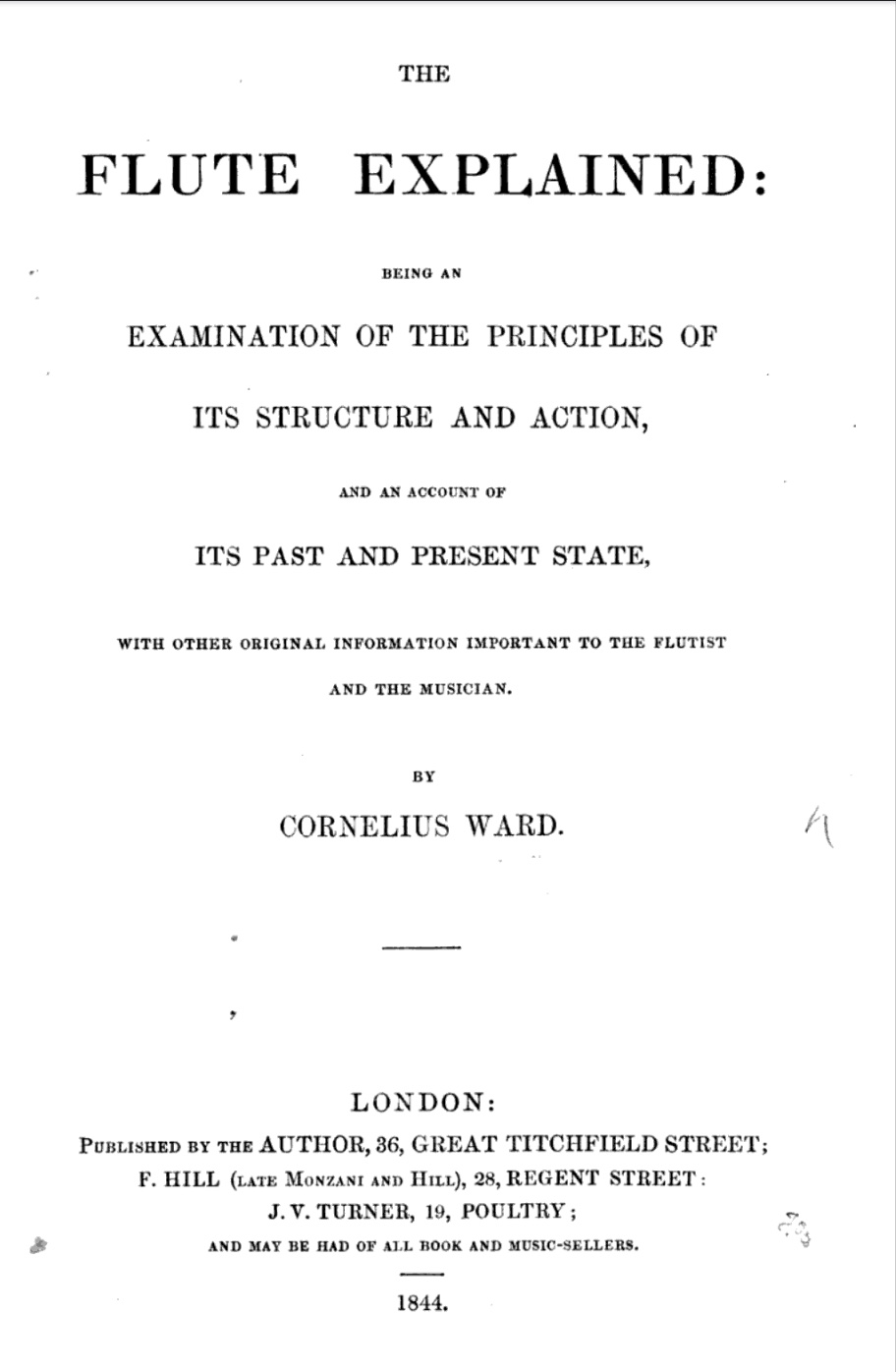
Ward emerged as an independent maker in London during the 1840s, precisely when Theobald Boehm’s new cylindrical flute was disrupting the market. The atmosphere was toxic. The “Battle of the Systems” spilled over into the press, with makers trading insults in the pages of The Musical World.
The mood of the time is best captured by a satirical poem published in 1843, by a writer calling himself “Embouchure,” who begged for an end to the noise:
I pray you sir, to put a mute
On all this noise ’bout Boehm’s flute;
Your powers arouse
To muffle Prowse
Nor let old Card
Contend with Ward
But quash at once the dull dispute.
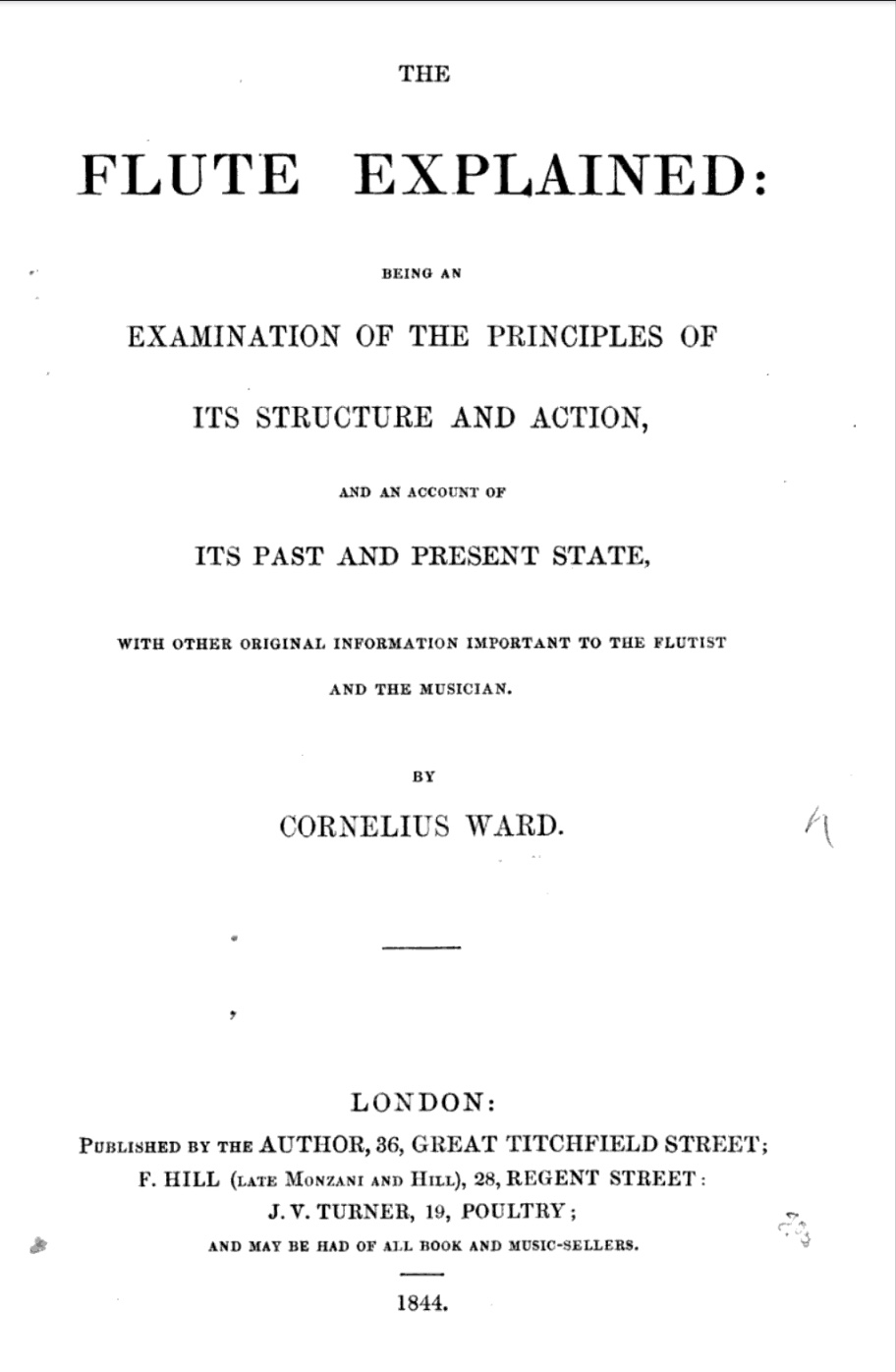
Ward, however, was not ready to quash the dispute. In his 1844 treatise The Flute Explained, he launched a full-throated attack on his German rival, famously dismissing the Boehm system as a “bungling compromise between tone, tune, and the ordinary dimensions of the human hand.”
Ward’s objection was rooted in acoustic purity. He believed that for a flute to be perfectly in tune, every tone hole had to be in its theoretically correct position. Boehm had solved the spacing problem by using rod-axles and rings to bridge the gaps that the fingers couldn’t reach. Ward, however, believed that any mechanism that kept a key closed (or linked it to another) “veiled” the sound. He wanted a system where every hole stood open, venting the air column freely until the finger depressed it.
He decided he would design a system where every finger controlled a specific hole directly. It was an acoustician’s dream, but a player’s nightmare.
The Thumb Killer: Patent No. 9229
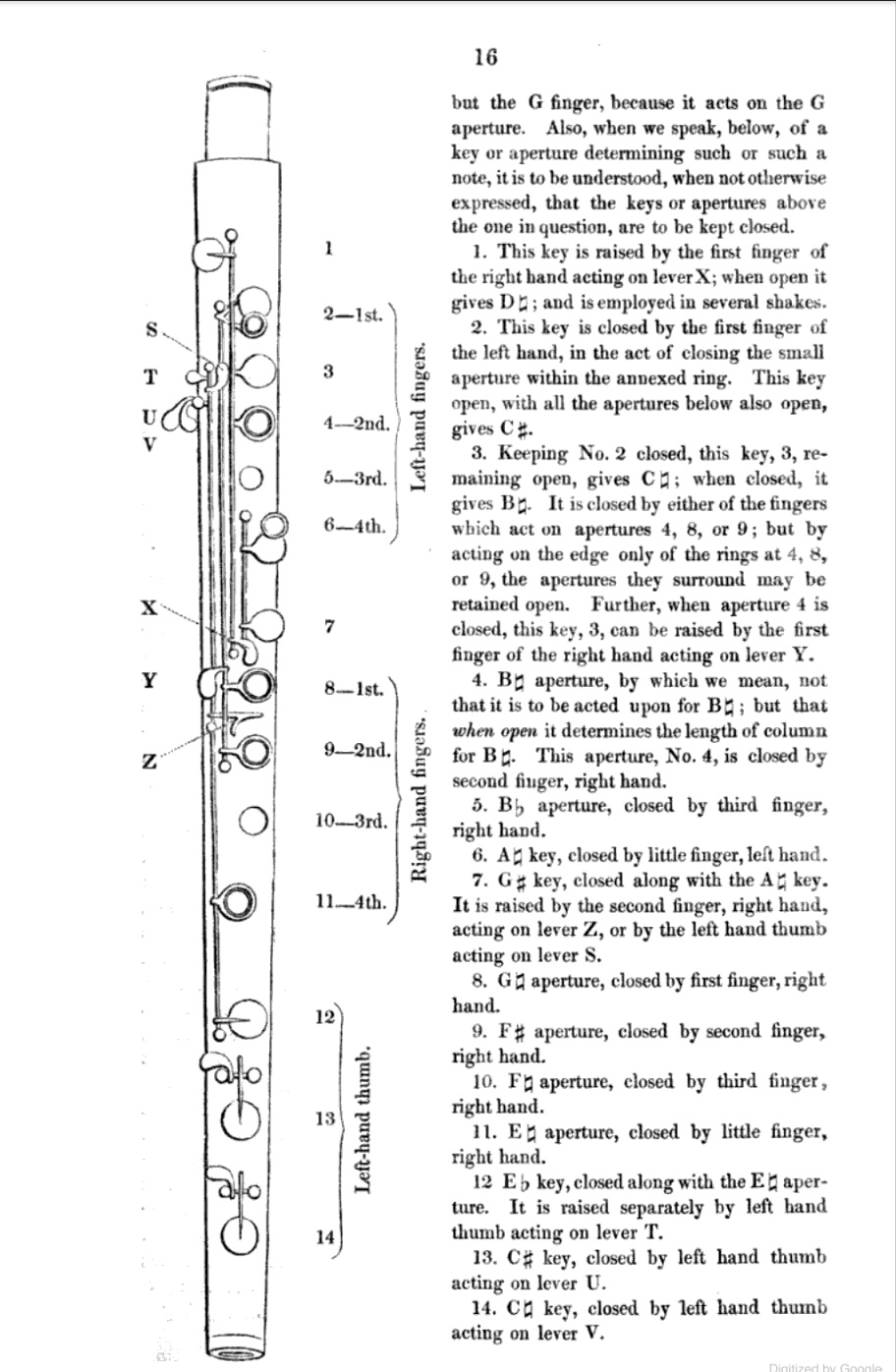
The result of this philosophy was Ward’s Patent Flute (Patent No. 9229, 1842). It was an engineering marvel that proved to be an ergonomic catastrophe.
To achieve his acoustic ideal, Ward assigned a specific job to each of the player’s fingers. The problem with this “one finger, one hole” logic was that it left no fingers available for the foot joint keys (C-sharp, C, B). In a standard flute, the right pinky handles these. In Ward’s system, the right pinky was already busy covering a tone hole to maintain his perfect spacing.
His solution, clearly visible on DCM 0572, was the infamous system of “traction levers.” Ward moved the control of the foot joint entirely to the player’s left thumb.
On these instruments, the player’s left thumb—already responsible for supporting the weight of the flute—was required to operate a terrifying array of heavy levers connected to long wires running the length of the body. As H. Macaulay Fitzgibbon noted with some sympathy in The Story of the Flute (1914), “this poor thumb had to work no less than five keys.”
To play a Ward flute was to engage in a feat of athleticism. The wires generated friction; the leverage was poor; the stretch was considerable. While the tone was reportedly huge and free (due to the large, open holes), the sheer physical strength required to manipulate the traction levers while keeping the instrument steady doomed it to obscurity. It was a triumph of mechanical engineering and a failure of human physiology.
The “Terminator” and the Quest for Precision

Ward’s obsession with correcting “flaws” that other players didn’t even notice extended to the headjoint. The Miller Collection highlights another of his inventions, a device he boldly named the “Patent Terminator and Indicator” (visible on his 1842 patent and extensively documented by historian Robert Bigio). While the name sounds jarringly modern to our ears—invoking images of science fiction robots—Ward meant it in the literal Latin sense: the mechanism that determines where the air column terminates.
For centuries, flutists have tuned their instruments by simply pulling the headjoint out. Ward argued that while this lengthened the tube, it created a cavity in the bore that distorted the internal proportions of the instrument, ruining the intonation of the upper octaves.
His solution did not eliminate the tuning slide; instead, it married the slide to the internal cork stopper. When a player pulled the slide out to a specific line engraved on the silver tube (say, No. 4), they were required to also turn a dial on the crown to the matching No. 4. This dial engaged a hidden internal thread that shifted the “Terminator” (the cork) inside the bore, perfectly realigning the air column’s geometry. “It was brilliant, precise, and—because it required two actions to perform what usually took one—utterly maddening for the user.”
It is worth noting that this design actually made the headjoint lighter, as it eliminated the need for the heavy metal lining found in standard tuning slides. However, the trade-off was a mechanism that required constant calibration. It was brilliant, precise, and utterly over-engineered—a hallmark of the Ward philosophy.
The Verdict of 1851
The “Battle of the Systems” came to a public head at the Great Exhibition of 1851 in London. This was the world stage where makers displayed their finest work. Ward was there, exhibiting his patent flutes. Theobald Boehm was there, exhibiting his new cylinder flute.
The result was a devastating blow to Ward’s ego and business. The Jury awarded Boehm the prestigious Council Medal, reserved for “important novelty of invention.” Ward, meanwhile, was awarded the lesser Prize Medal. While the Prize Medal acknowledged his “excellence of workmanship”—a fact no one could dispute—the Council Medal signaled that the world had accepted Boehm’s scientific principles over Ward’s mechanical complexity. The industry had chosen its future, and it was not the traction lever.
Beyond the Flute: The Industrialization of Rhythm
If Cornelius Ward’s legacy in the flute world is one of beautiful failure, his legacy in the wider world of music is one of quiet, ubiquitous revolution. While the Miller Collection is dedicated to the flute, to understand the man, we must look at his work in percussion.
In the early 19th century, drums were essentially medieval technology. They were tuned by tightening ropes (catgut) laced through leather “ears.” This system was a nightmare for military bands; a humid day or a rainstorm would cause the ropes to slacken, rendering the drums unplayable.
In 1837, Ward applied his toolmaker’s mind to this problem and secured Patent No. 7392. He dispensed with the ropes entirely. Instead, he introduced a system of metal rods and screws that connected the top and bottom hoops. By turning a key, a drummer could tension the head evenly, regardless of humidity.
Ward’s invention of screw tensioning is the standard system used on almost every snare drum and tom-tom today. Every time a modern drummer tunes their kit, they are using Ward’s design. He effectively brought the drum out of the Middle Ages and into the Industrial Revolution.
His work in percussion even extended to the bizarre. When the famous Richardson family toured with their “Rock Harmonicon”—a massive lithophone made of musical stones—it was Ward who designed and built the custom pedal-operated bass drums that accompanied the stones. According to historical accounts, Ward had effectively mechanized the rhythm section decades before the invention of the modern drum kit.
His reach was truly exhaustive. The Flute Almanac notes that Ward, in cooperation with Giuseppe Tamplini, manufactured the first Boehm-system bassoon in 1851, and the catalogue of the Royal Military Exhibition credits him with distinct improvements to the clarinet, noting that the clarinet “has been considerably improved, first by Cornelius Ward.”
The Wheatstone Connection: A Meeting of Minds
Ward’s relentless drive to mechanize music was not an isolated phenomenon; it was the family business. Genealogical records confirm a fascinating and powerful link: Cornelius Ward was married to Harriet Ryder.
Harriet was born in Barnwood, Gloucestershire, in 1793. This is the key detail. Barnwood was also the birthplace of her first cousin, Sir Charles Wheatstone.
Wheatstone is a titan of Victorian science—the inventor of the Wheatstone bridge, a pioneer of the telegraph, and the inventor of the concertina. The connection between Ward and Wheatstone places Ward in the center of one of the most vibrant intellectual circles of 19th-century London.
One can easily imagine the conversations at family gatherings. On one side, Wheatstone, the physicist obsessed with the transmission of sound and electricity. On the other, Ward, the master mechanic obsessed with leverage and tension. It is likely they influenced each other; Ward’s knowledge of metal reeds and air pressure would have been invaluable to the development of the concertina, just as Wheatstone’s acoustic theories likely fueled Ward’s “Anti-Boehm” treatises.
This bond was lifelong. In a final, poetic testament to their connection, Ward is buried in London’s Kensal Green Cemetery. His gravestone stands directly next to that of Wheatstone.
A Tragic End
Despite his brilliance, his patents, his “jewel-like” craftsmanship, and his connections to the scientific elite, Ward’s story does not have a happy ending. The Victorian market was cruel to those who prioritized perfection over practicality.
Ward’s flutes were expensive to make and difficult to play. His refusal to compromise his acoustic principles for the sake of ergonomics meant that while professionals admired his workmanship, few bought his instruments. The “Battle of the Systems” was won by Boehm, and Ward’s traction levers became curiosities rather than standards.
The decline was steep. While early descriptions of his family suggest the “visible wealth” of a successful tradesman, by the end of his life, the money was gone.
In the 1871 Census, an aging Ward is listed as a “Retired Musical Instrument Maker,” living with his son-in-law Richard Tillstone at 14 Alma Square, Marylebone. But the stability did not last. Historical records uncover a devastating final chapter. Ward died on February 1, 1872, not in a comfortable home surrounded by his inventions, but inside the Marylebone Workhouse.
The workhouse was the Victorian institution of last resort—a place of destitution and shame. It was not merely a shelter; it was a place of regimented hardship designed to deter the poor from seeking aid. Inmates were separated from their families, forced to wear uniforms, and often required to perform menial labor. It is a stark, heartbreaking contrast. The man whose hands crafted silver keys of unsurpassed beauty, whose inventions are used in every symphony orchestra and rock band in the world today, ended his days in the custody of the state, a pauper.
While his business failed, his bloodline remained in the industry. His son, Richard J. Ward, eventually moved to Liverpool and established himself as a successful instrument dealer, keeping the family name alive in the concertina and flute trade well into the next century. But for Cornelius, there was no such comfort.
The Legacy
Cornelius Ward was a perfectionist who understood machines better than he understood the market. He demanded too much of the player’s thumb and too much of the buyer’s wallet. But to view him as a failure is to miss the point.
Through the Dayton C. Miller Collection and the surviving instruments scattered across the world’s great museums, we are able to look past the ergonomic quirks of his designs and see the mind at work. We see a man who refused to accept the “bungling compromises” of his era. We see the father of modern drum tuning. We see a collaborator of Wheatstone.
In the quiet vaults of the Library of Congress, Ward’s flutes still gleam with a precision that defies their age. They stand as a monument to a specific, magnificent kind of failure: the failure of a man who tried to force the messy reality of music into the perfect logic of a machine.
Primary Holdings: The Dayton C. Miller Collection (Library of Congress)

DCM 0044: Flute in C (Ward’s Patent)
- Description: A cocuswood flute with silver keys and fittings. This instrument features Ward’s 1842 patent mechanism and the original “Patent Terminator and Indicator” tuning headjoint.
- Significance: One of the earliest and most complete examples of Ward’s “Anti-Boehm” system.

DCM 0572: Flute in C (Ward’s Patent)
- Description: Cocuswood with silver keys.
- Significance: Displays the complex “traction lever” system for the left thumb, illustrating the ergonomic challenges of Ward’s design philosophy.

DCM 1137: Flute in C (Ward’s Patent)
- Description: Cocuswood with silver keys.
- Significance: A high-grade example of Ward’s craftsmanship, stamped with his address at 36 Great Titchfield Street, London.

- Description: Cocuswood with silver keys.
- Significance: Miller thought this had a very unusual system of keys and was unique:
- It had a scale to low B-flat.
- The body was made in one piece and pitched to low C-natural but…
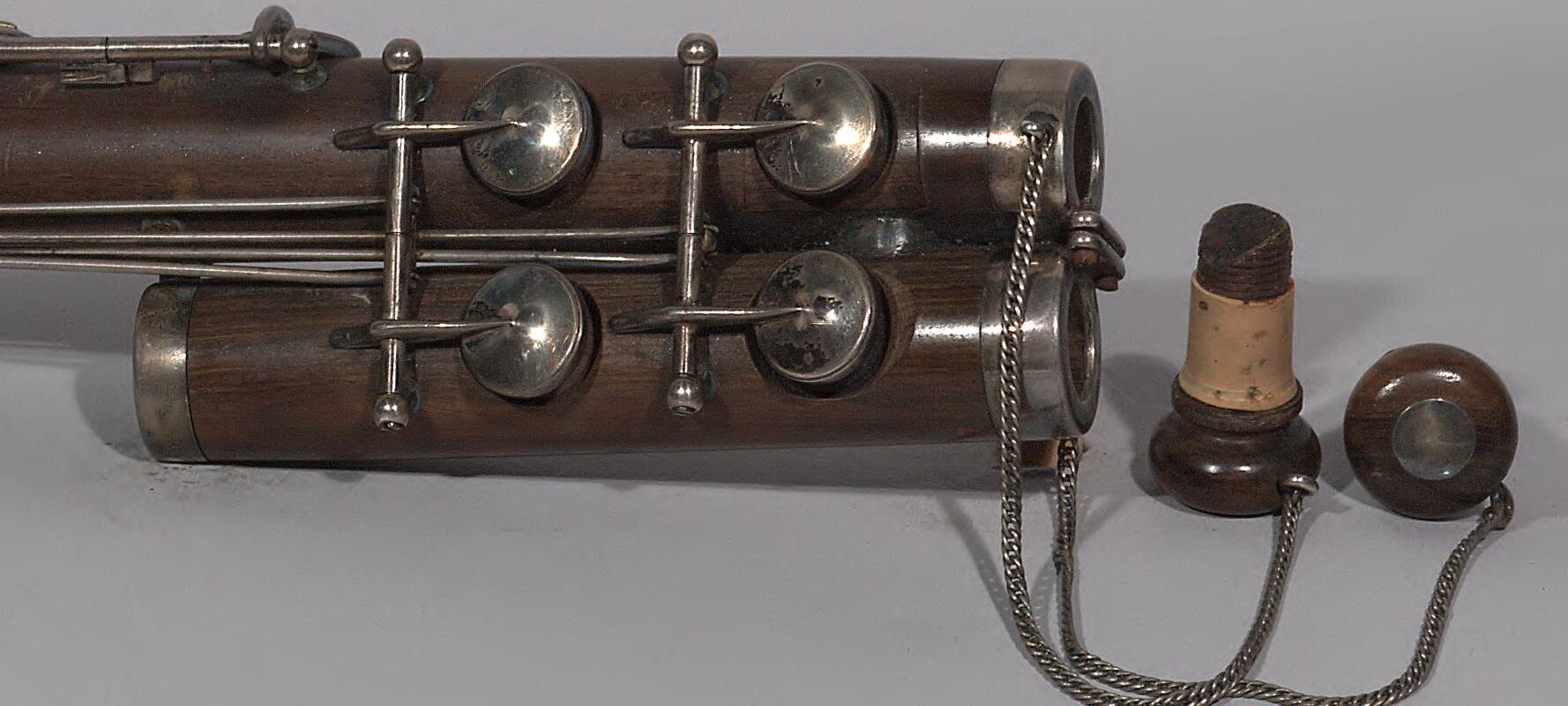
- There was a short tube connecting with a foot-piece via a cross-tube that had two wood pieces (attached to dangling chains) designed to be inserted into the open lower ends of the one-piece body. This then extended the range of the entire assembled flute down to low B-flat.
- The four lower keys were operated by a “Bell Crank” wire system to levers operated by the left thumb.

DCM 1260: Flute in C (Ward’s Patent)
- Description: Cocuswood with silver keys.
- Significance: Another variation of the 1842 patent system, providing a comparative study for the evolution of Ward’s keywork mechanics. Miller noted that this flute has unusually complicated levers for cross connections. This intricate mechanism was an attempt to improve the flute’s fingering system and intonation before the Boehm system became the widely accepted standard. While ingenious, its complexity likely contributed to the difficulty for players to adopt it widely, a common issue during the period of intense development and rivalry among different flute systems in the mid-19th century.
- There were raised plates for both thumbs and for the left knuckle.
- The left-hand thumb had to operate no fewer than five keys that were used to:
- close the two low C keys via long traction levers;
- manage keys for E-flat/D-sharp and G-sharp/A-flat, utilizing the Dorus G-sharp key principle assigned to different fingers.
- Everything was elaborately engraved.
- And… it has a nearly square embouchure hole.
- (Author’s note: it’s hip to be square.)
Select Institutional Holdings of Cornelius Ward Instruments
While the Library of Congress maintains the definitive collection of Ward’s patent flutes, significant examples of his work—including his percussion inventions—are preserved in major collections worldwide.
The Metropolitan Museum of Art (New York, NY, USA)
• Flute in C (c. 1850): A fine example of Ward’s later work, featuring a cocuswood body and silver keys (Accession Number: 89.4.3241).
The National Music Museum (Vermillion, SD, USA)
• Flute in C (c. 1842): A pristine example of the Ward Patent system (Patent No. 9229) featuring the Patent Terminator headjoint mechanism (Object ID: 00744).
The Bate Collection of Musical Instruments (University of Oxford, UK)
• Conical Boehm Flute: A rare example of a flute stamped by Ward but built to the Boehm system he publicly criticized, demonstrating his commercial adaptation (Catalog No. 75).
• Ward Patent Flutes: Several examples of his 1842 system (Catalog Nos. 247, 521).
Museum of Fine Arts (Boston, MA, USA)
• Flute (c. 1845): Cocuswood with silver keys, utilizing Ward’s patent mechanism (Accession Number: 1989.204).
The Horniman Museum and Gardens (London, UK)
• Boosey & Hawkes Collection: Houses multiple Ward flutes acquired through the absorption of historical London makers, including examples of his collaboration with other firms (Object Numbers: M19-1988, 2004.852).
University of Edinburgh / St Cecilia’s Hall (Edinburgh, UK)
• Flute Nominal Pitch C: An eight-keyed flute manufactured by Ward, originating from the Glen and Macaulay collections (Work Record ID 0032044 ID Number 46).
Keswick Museum (Cumbria, UK)
• Rock Harmonicon Mechanism: Preserves the original pedal-operated bass drum mechanism designed and built by Cornelius Ward for the Richardson family’s lithophone.
Endnotes
| ↑1 | Readers: Fascinatingly, we couldn’t find an image of him. Do you know of one, or have access to any sites behind paywalls that might have one? If you find something, please send it our way! |
|---|