


Part 1: The Allure and Context of Walking Stick Flutes

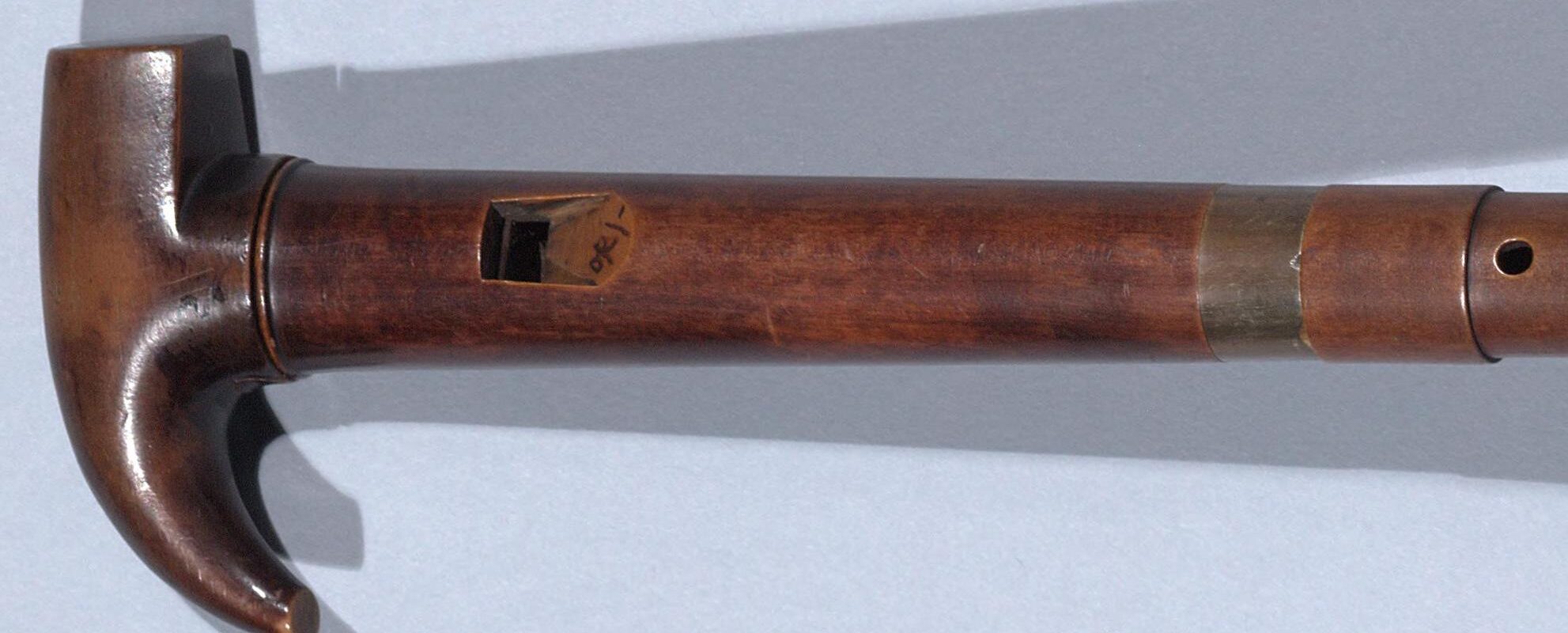
Imagine strolling down a bustling 19th-century street, or perhaps hiking to a friend’s home for an evening of chamber music. In hand, you carry not just an elegant accessory or a sturdy support but a hidden source of melody: a flute concealed within your walking stick. These fascinating objects, born from a unique confluence of fashion, practicality, and musical inclination, offer a tangible link to the social customs and inventive spirit of past eras. Understanding the history and ownership trail (the provenance) of such instruments, as explored previously in The Flutist Quarterly, is key to fully appreciating their journey and significance. Preserving a remarkable array of these “concealed melodies,” complete with tantalizing provenance clues, is the Dayton C. Miller Collection at the Library of Congress, a treasure trove for anyone interested in the history of the flute and its myriad forms.
This article delves into the world of walking stick flutes, exploring their historical context, the varieties represented in the Miller Collection, and highlighting several particularly intriguing examples whose stories underscore the importance of provenance research. Our exploration draws upon the rich resources of the Miller Collection, including the instruments themselves, Dayton C. Miller’s meticulous acquisition records, and associated correspondence that sometimes reveals surprising personal connections.
The Walking Stick: From Utility to “Gadget Cane”
To understand the walking stick flute, we must first appreciate the status of the walking stick itself. From the 17th century onwards, and especially during the 18th and 19th centuries, the cane transcended its function as a mere mobility aid. It became an essential accessory for any gentleman* of standing, a symbol of authority, wealth, and refined taste. (This reflects the strongly defined gender roles of the time, where such public accessories and the activities associated with them were primarily the domain of men.) By the 18th century, carrying a walking stick was an integral part of a gentleman’s daily attire, so much so that in London in 1702, a license was required to carry one, accompanied by specific rules governing its public deportment.
Playing Their Parts: Gender Roles and Music Making in the 18th and 19th Centuries
The world of music in the 18th and 19th centuries was heavily influenced by societal expectations regarding gender. While men dominated professional music, composition, and the playing of most orchestral instruments, music was considered a vital “accomplishment” for women of the middle and upper classes, albeit within specific boundaries:
● Acceptable Instruments: Women were primarily encouraged to play keyboard instruments (harpsichord, piano), harp, guitar, and lute, along with singing. These were deemed suitable for the domestic sphere, displaying grace, refinement, and the family’s ability to afford lessons. Playing these instruments often showcased posture and delicate hand movements considered attractive.
● “Unladylike” Instruments: Wind instruments (including the flute, often cited for its “phallic shape” or potential to distort facial features), brass instruments (seen as too loud or requiring too much physical exertion), percussion (associated with the military), and often bowed strings like the violin or cello (requiring postures or physical efforts deemed “unfeminine”) were generally discouraged. Playing such instruments could be seen as transgressing gender boundaries or associated with lower social classes or male professionals.
● Performance Context: The primary venue for female amateur musicians was the home, performing for family and guests. Public performance, especially instrumental, was often considered improper or damaging to a woman’s reputation, although exceptions existed, particularly for vocalists or, increasingly later in the period, highly talented instrumentalists (often from musical families).
● Music as Accomplishment: For many women, musical proficiency was cultivated less for artistic expression and more as a social asset, enhancing eligibility for marriage.
While many talented women composed and performed on a wider range of instruments throughout this period (including pioneering flutists and even makers like Barbe Naust), they often faced significant societal hurdles and biases not experienced by their male counterparts. The types of instruments concealed in walking sticks largely reflect this gendered landscape of musical practice.

The materials employed in their crafting were diverse, ranging from practical woods like ash or hazel to luxurious substances such as ivory, whalebone, ebony, malacca cane, and even more exotic choices like bamboo, glass, or porcelain. Handles, in particular, became focal points for artistic expression, frequently adorned with precious metals like silver and gold or featuring intricate carvings and jeweled embellishments. The walking stick thus became a canvas for personal expression and a public declaration of one’s societal position.
Its very prominence and the cultural value placed upon it naturally led to innovations. The 19th century, an age of burgeoning industrialization and mechanical fascination, saw the rise of the “system cane” or “gadget cane.” These were marvels of ingenuity, concealing everything from professional tools (medical instruments, measuring devices) to personal conveniences (telescopes, flasks, tobacco compartments) and even defensive implements (swords, daggers). Among the most charming and popular inclusions were musical instruments. Because gentlemen already carried canes as a matter of course, incorporating a flute or a small violin (pochette) was a clever extension of an existing fashion, offering portable entertainment in a discreet package. This blend of utility, fashion, and personal expression created a fertile ground for the walking stick flute to flourish.
While gentlemen adapted their canes to conceal tools, drinks, weapons, and instruments, women of means had their own complex accessories, though direct parallels for concealed musical instruments seem rare or undocumented. Elaborate travelling cases (necessaires de voyage) and decorative tie-on pockets held essential items for toilette, correspondence, sewing, or managing households—perfume bottles, powders, mirrors, combs, writing implements, thimbles, scissors, keys, and sometimes even valuable miniatures, snuff boxes, or smelling bottles. Parasols and fans, key elements of female attire and social interaction, sometimes contained hidden compartments, but typically for small items like perfume vials or perhaps a miniature portrait, rather than functional musical instruments like flutes or violins. This difference highlights the distinct social spheres and expected activities associated with men’s and women’s accessories during this period.
Varieties Under the Handle: Flutes, Czakans, Flageolets, and a Shakuhachi
Renowned physicist, acoustician, and passionate flutist Dayton C. Miller (1866–1941) recognized the historical value of these instruments. His bequest to the Library of Congress included an astonishing variety of walking stick wind instruments. Based on Miller’s records and the instruments themselves (the Miller Collection Checklist), the collection houses examples across several distinct categories:
| Instrument Type | # in Miller Coll. | Brief Description |
| Walking Stick Flutes | 15 | Standard transverse flutes adapted into walking stick form; various woods & keys. |
| Walking Stick Czakans | 2 | Recorder-like duct flutes, often keyed; popular in 19th c. Austria-Hungary. |
| Walking Stick Flageolets | 3 | Simple fipple flutes (related to recorder/tin whistle); often used by amateurs. |
| Walking Stick Shakuhachi | 1 | A unique hybrid incorporating the traditional Japanese end-blown bamboo flute. |

The most common type is the standard Walking Stick Flute (Transverse), often called cannes-flûtes in France. These adapted the familiar transverse flute, usually made of wood like boxwood, maple, or grenadilla, fitting its sections within the cane structure. Keywork ranged from none to multiple keys, and makers sometimes employed clever camouflage, carving the wood to resemble bamboo or even fashioning keys to look like twig stumps. Examples like DCM 0271 and DCM 0841 showcase this variety well (see Part 2 for details).
The Walking Stick Czakan (or Csákány) represents a specific tradition. Originating likely in Austria-Hungary around 1806–10, this keyed duct flute, built into a walking stick, filled a niche left by the declining art-music recorder. Popularized by figures like Anton Heberle, it even developed its own repertoire of over 400 pieces, showing it was taken seriously as an instrument, particularly among amateurs in Vienna. Early examples might have one key or none, but more complex versions with six or more keys evolved. DCM 684 (by J. Merklein) and DCM 0727 (Anonymous) are the examples in the Miller Collection.
The Walking Stick Flageolet incorporated another type of fipple flute, simpler than the Csakan and widely popular among amateurs since the late 16th century. Both French (typically 4 front/2 back holes) and English (6 front holes, sometimes keys) types existed. Their relative simplicity made them easy candidates for concealment within a cane. DCM 0824 and DCM 1232 represent this type in the collection.
Perhaps the most culturally intriguing is the single Walking Stick Shakuhachi in the collection, DCM 1133. This instrument merges the form of the traditional Japanese end-blown bamboo flute (Shakuhachi), deeply connected with Zen Buddhism and meditative practice (suizen), with the Western accessory form. It stands as a fascinating example of cross-cultural adaptation or innovation (see Part 2 for details).
Spotlight on Intriguing Examples: Provenance and Mysteries
The study of provenance—tracing an instrument’s history of ownership, modification, and use—brings artifacts like these walking stick flutes to life. The following four instruments from the Miller Collection each offer compelling narratives embedded in their physical form and documented past, showcasing the rewards and challenges of provenance research.
Part 2: In-Depth Analysis of Selected Key Instruments
An Early American Gem: DCM 0271 (Jacob Anthony, Philadelphia, 1764)
 One of the earliest walking stick flutes acquired by Miller offers a remarkable glimpse into colonial American craftsmanship. Cataloged as DCM 0271, this transverse flute in C bears the stamp “ANTHONY / PHILAD,” attributing it to Jacob Anthony. What makes this instrument astonishing is its date: Library of Congress records indicate it was made in 1764. Jacob Anthony (likely born in Germany in 1736, d. Philadelphia 1804) established his workshop in Philadelphia in the 1760s, making him one of America’s earliest known woodwind makers. Surviving instruments from his workshop are exceedingly rare—the Library of Congress notes only four instruments from the Anthony workshop have surfaced (an example of an Anthony oboe is at the Metropolitan Museum of Art), described as “curious” given the workshop’s longevity (half a century according to city directories). DCM 0271 is thus a critically important document of early American musical instrument making.
Crafted from an unidentified stained wood with remnants of dark varnish, the instrument features a stunning and unusual decorative element: 68 meticulously hand-carved, raised “knots” adorning oversized ferrules along its 95.5 cm length, giving it a rustic, perhaps faux-natural look. This distinctive decorative feature is also noted on other instruments in the Miller Collection (DCM 1231 and DCM 1662). The pommel has an ivory cap, beneath which is engraved an enigmatic monogram: “INH (?).” Cord holes are bushed with ivory (one is a replacement). The foot terminates in a brass ferrule and iron tack.
Originally equipped with four keys (now missing) with ivory-bushed toneholes, the key mounts are simple recessed slots, suggesting the keys were designed to be instantly removable—a practical feature for an instrument meant for travel. Further evidence of its use and history comes from modifications: the toneholes for B-flat, G-sharp, and F are plugged with cork, implying a past owner preferred to play it essentially as a one-key (E-flat) flute. The plugging itself is a piece of provenance, showing adaptation by a player long ago.
Its later provenance adds another layer of interest. Miller received it as a gift on August 24, 1922, from Mr. W. P. Harrell of Portsmouth, Virginia. Miller valued it at $25 at the time. Correspondence preserved in the Miller Collection reveals Harrell was an amateur flutist, played in the Norfolk Civic Symphony Orchestra (organized 1920), and sent the flute in gratitude after Miller sent him a copy of his 1922 book on Boehm. Their correspondence continued for years, including Harrell’s excited “fan letter” after hearing Miller speak about flutes on the radio in 1931. While this clarifies Harrell’s connection to Miller, the earlier provenance puzzle remains: How did this 1764 Philadelphia flute reach Virginia and W.P. Harrell by 1922?
The “INH (?)” monogram also remains a compelling mystery. Could it belong to the original owner, likely an affluent Philadelphian from the 1760s? Considering the convention of “I” for “J,” perhaps “JNH”? Research into prominent Philadelphia families has yet to yield a definitive match. Could the ‘H’ possibly link to Harrell’s ancestry, despite the geographical distance and time? This provenance puzzle highlights the type of investigative work often involved in understanding instrument histories and requires deeper archival research. The instrument’s condition—missing keys, plugged holes, cracked socket, worn threads, damaged pommel tenon—further speaks to its long life and journey.
A Dated Enigma: DCM 0841 (Anonymous, Inscribed “G. Wetherbee / 1851”)
 Another transverse walking stick flute, DCM 0841, presents a different set of provenance puzzles and charms. Cataloged as anonymous, potentially English or American, and made in the mid-19th century, its most striking feature is an inscription: “G. Wetherbee / 1851.” This appears on a plaque at the top of the instrument, according to the Library of Congress record. The instrument itself is likely maple, distinguished by a beautiful mottled finish achieved through acid staining, a technique used to enhance the wood’s figure (a similar finish appears on another Miller walking stick flute, DCM 0982). It has an ivory pommel and four simple keys mounted via the “pin in block” method.
The date 1851 provides a firm anchor point. Who was G. Wetherbee? Unlike the INH monogram, this inscription offers a name and date, fueling specific genealogical research. The Wetherbee family was prominent in Massachusetts. Research reveals a compelling possibility: Josiah Quincy Wetherbee (b. 1815), a Massachusetts resident, had a son, George Faulkner Wetherbee (later a noted painter), born in 1851. Could the flute have been commissioned or acquired by Josiah, a Massachusetts resident, to commemorate his son George’s birth? The initials “G. Wetherbee” would then refer to the infant George.
This hypothesis gains traction from the instrument’s later provenance. Miller acquired it on April 5, 1929, for $20.00 from G. L. Tilden of Northboro, Massachusetts. Tilden responded to an ad Miller had placed in the Boston Evening Transcript. Subsequent research confirmed G.L. Tilden was an active antiques dealer in Northborough during this period. Acquiring a flute with potential Massachusetts family connections from a Massachusetts dealer strongly suggests a New England history, making the George Faulkner Wetherbee birth commemoration theory plausible, though not definitively proven. How Tilden acquired the flute remains unknown. The anonymity of the maker underscores another common provenance challenge.
Echoes in Maple: DCM 0824 (Anonymous Walking Stick Flageolet)
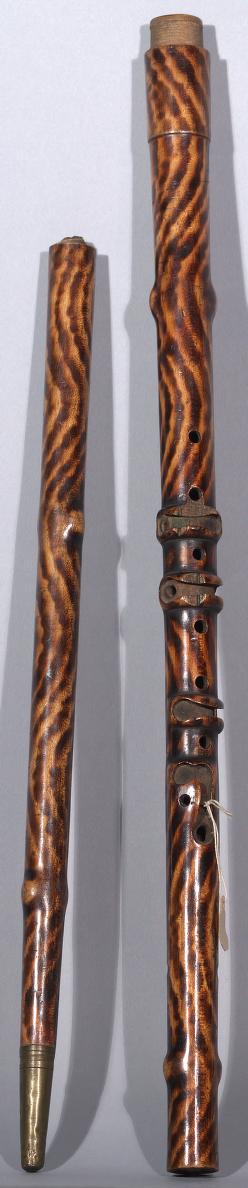 Representing the flageolet variety, DCM 0824 offers insights into materials and use-life. Likely made of maple, it shares the distinctive acid-stained (“grained” décor) finish seen on the Wetherbee flute (DCM 0841), hinting at a possible link in workshop origin or aesthetic preference. This simple fipple flute originally had four wooden keys (now missing).
Its significance lies partly in its compromised condition: the pommel is missing, all four keys are absent, key blocks are broken, and the lower tenon is broken off. This damage narrates a story of its functional life, subject to the combined stresses of musical use and daily service as a walking aid. Miller acquired this instrument from Carolyn A. Alchin of Los Angeles on December 15, 1928, adding another geographical point to its partially known provenance.
East Meets West: DCM 1133 (Anonymous Walking Stick Shakuhachi, 1932)
P erhaps the most unusual specimen chosen for this spotlight is DCM 1133, identified as a Walking Stick Shakuhachi. Made of traditional bamboo, this end-blown flute adopts the walking stick form but retains the essential character of the Japanese Shakuhachi. Its bakelite cap points to its 20th-century manufacture, confirmed by the date 1932.
This instrument poses fascinating questions about cultural exchange and provenance. Is it a Western maker’s novelty adaptation of an “exotic” instrument? Or a Japanese innovation, perhaps a modern echo of practicality for traveling players? Its anonymity obscures its precise origins. Acquired by Miller, its presence alongside traditional Shakuhachis in the collection highlights both its shared heritage (material) and its unique, hybrid form. It reminds us that the modification and recontextualization of musical instruments across cultures continued well into the 20th century.
The Collector and the Collection’s Value for Provenance
These instruments, rich with stories and unanswered questions, underscore the value of the Dayton C. Miller Collection. Miller’s vision of instruments as historical documents, coupled with his meticulous (if sometimes incomplete) records noting sources like W.P. Harrell and G.L. Tilden, provides researchers with invaluable starting points. The survival of associated correspondence further illuminates the human connections behind the collection. Investigating the provenance of these objects allows us not just to understand the instruments themselves but also the lives of those who made, owned, played, and preserved them.
Enduring Mysteries and Legacy
The study of walking stick flutes continues to present challenges: unmarked makers, fragmented ownership histories, the dual nature of the objects themselves complicating research. Fully unraveling the stories of the “INH” monogram or the precise circumstances of the Wetherbee flute requires dedicated, interdisciplinary investigation.
These enigmatic instruments remain undeniably captivating. They stand as elegant testaments to an era when craftsmanship, fashion, musicality, and practicality ingeniously converged, reflecting both the ingenuity of their makers and the desire of owners to carry music hidden in plain sight. The Dayton C. Miller Collection, through its meticulous preservation of these fragile and fascinating artifacts and their associated records, allows us invaluable glimpses into this unique chapter of musical and social history. Indeed, the allure of these creations endures. As Carol Lynn Ward-Bamford has observed, “I do notice that everyone, Lizzo included, always walks away from seeing the walking stick flutes by saying, ‘I need to get one of those!’” It’s a reaction many of us (the author included!) can understand, and perhaps it’s the ultimate testament to their unique appeal: these instruments, designed to accompany a walk, inspire an immediate desire to walk away with one. They truly embody a singular moment when music, fashion, and utility strode elegantly together, reminding us that every flute has a story waiting to be uncovered.
References
• Robert Rabinowitz. “Do You Know Your Flute’s History? Provenance and the Stories Behind Our Instruments.” The Flutist Quarterly, Winter 2025, Volume 50, No. 2.
• Literary Liaisons. “History of the Walking Stick.”
•”History – Basedau – fine old walking canes.”
• Wenner Flöten. “J. Ziegler, Csakan, A flat.” Accessed May 8, 2025.
• “Flageolet (musical instrument).” Accessed May 8, 2025.
• Jordan, Hester Bell. (2012). “Transgressive gestures: women and violin performance in eighteenth-century Europe” (PhD Thesis). Massey University. Via Massey Research Online: massey.ac.nz/bitstream/handle/10179/10595/02_whole.pdf
• Relevant genealogical resources (e.g., FamilySearch.org, Ancestry.com) for Philadelphia families research.
• Email and phone communications between Carol Lynn Ward Bamford and Robert Rabinowitz.
All images courtesy Dayton C. Miller Collection, Music Division, Library of Congress.