


The Series So Far
- Part 1: Finding Unity in Sound explored the shift from the “ritual” of focused listening to our current age of sound saturation, questioning how this affects our attention.
- Part 2: From Convention Hall to Practice Room moved the practice from communal soundscapes to the focused intimacy of the practice room, exploring embodied listening as a “conversation among friends”.
- Part 3: The World as Score investigated the source of listening through Pauline Oliveros’s concept of Deep Listening®, focusing on how the way we listen creates our life.

In the heat of the Hill Country in Texas, a house doesn’t just sit; it breathes. After 55 years on this concrete slab, the frame has developed its own vocabulary of expansion and contraction. It is a slow, thermal glissando that only reveals itself in the transition between the 100-degree afternoon and the cooling evening. To the “Open-Eared” listener, these aren’t just cracks and pops. They are the house’s feedback loop with the earth.
This is the reward of Hard Listening: the capacity to hear the infrastructure of my own life. It is an investment in wonder that makes the mundane resonant. In Part 1: Finding Unity in Sound, I defined Hard Listening as the intentional exertion of focused cognitive and/or emotional effort required to deeply engage with, interpret, and understand music or sound that presents significant challenges through its complexity, density, unfamiliarity, or difficult content. It is the work we apply when navigating the “Musical Plane” described in Aaron Copland’s What to Listen for in Music. We often think of this as a burden of discipline. In reality, it is the hard work that builds an infrastructure of appreciation. It is the literal labor of the shovel. Just as digging a well is a grueling physical task that eventually strikes a sanctuary of water, the focused effort of Hard Listening provides a sanctuary of meaning within sounds that others might dismiss as “noise”.
Now imagine that peace being punctured. Imagine sitting in your living room during one of those cooling transitions when the “symphony” is abruptly interrupted. Imagine, from the street outside, a low-frequency thrum that vibrates through the floorboards, masking the house’s natural rhythm. Then comes the sharp, high-pitched chirp of a siren that shatters the meter. In that second, the “score” changes. The refrigerator hum is still there, and the ceiling fan still turns, but your ears—and your body—have shifted. The tension of the Somatic Witness replaces the peace of the meditative listener.
Flutists can spend decades practicing to filter out the “noise” of their own mechanics—the clicking of keys, the hiss of the breath—to present a sanitized, beautiful line. But as we move further into this exploration, we can confront a difficult truth: to listen only to what is beautiful is a luxury. To listen to the dissonance of our world, and to do so without flinching, is an act of courage.
The Capacity for Institutional Dissonance
In recent musicology and social theory, the term “Institutional Dissonance” has emerged to describe the jarring gap between an organization’s stated values and its operational reality. In music, dissonance demands resolution. In society, it is the painful tension felt when the discourse of community is met with the reality of enforcement. For many of our neighbors—specifically those experiencing administrative or environmental upheaval—this is the acoustic reality of their lives.
To claim to be an active listener today is to recognize that the hard work we put into mastering a complex piece of music rewards us with a massive expansion of our “inner ear”. As a side effect, it gives us the capacity to hold the same focus for social dissonance that we have for musical dissonance. There is a subtle but vital distinction here between two giants of listening. Pauline Oliveros believed that everything around us is already part of the score. While Aaron Copland invites us to listen for the “Musical Plane,” the composer Luciano Berio takes it a step further, suggesting that “Music is everything that one listens to with the intention of listening to music”. Oliveros offers us an open door; Berio offers us a lens. When we apply Berio’s intentionality to the world, we choose to hear the “human tone” as a primary subject, even in the most discordant environments.
The Rhythmic Floor: Pulse, Meter, and Tension
We can define the Rhythmic Floor as the predictable, underlying pulse of our daily lives. In a stable community, the heartbeat of the neighborhood and the mental grid we overlay on that pulse function in sync. We move through our days expecting the world to follow a predictable 4/4 meter. However, when unpredictable disruption or heavy surveillance invades an environment, it shatters that shared pulse. A sense of deep unpredictability replaces it.
For the musician, rhythm is a framework of intention. But the intrusion of authoritative force into a neighborhood carries no rhythm. It is an external force that breaks the pulse of the community entirely. Imagine a soft, quiet melody for flutes, harp, and strings—a moment of communal peace—that is suddenly, harshly interrupted by a loud drum and brass military insertion. This is the Rhythmic Floor shifting.
As musicians, we know the immense focus required to play a work where the meter is frequently changing. That same technical ear allows us to identify when an external force breaks the “pulse” of our community. This isn’t a chore. It is the satisfaction of being someone who truly understands the score, rather than someone who is just deafened by the noise.
Interference and the Use of the Self
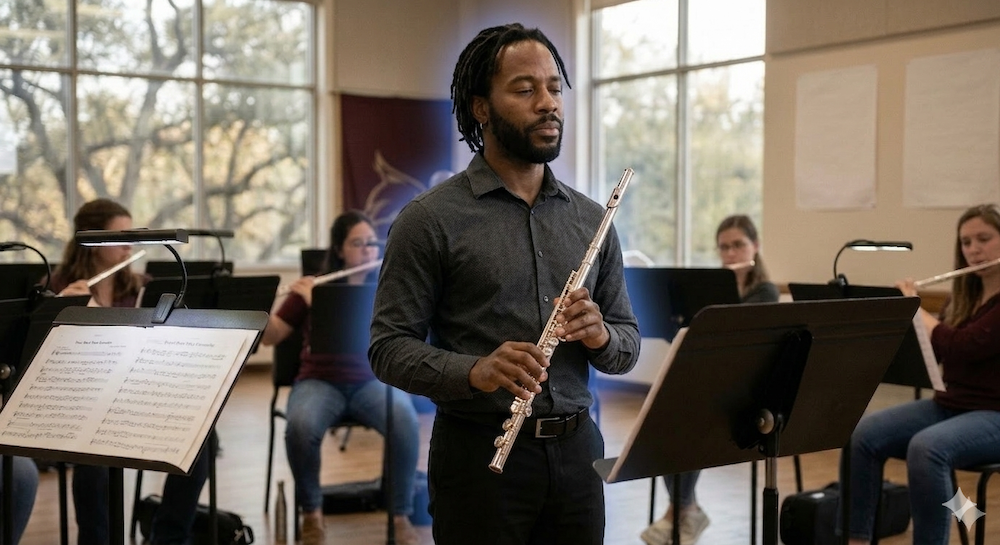
Building on the professional focus required for the high-stakes environments explored in Part 2, From Convention Hall to Practice Room, we often experience a physical reaction when the social score becomes similarly authoritative. For many musicians, this manifests as a “catch” in the breath when a conductor stops the rehearsal to stare at our section, or when a panel of judges sits in the dark during an audition. This is more than mere nerves; it is a somatic response to external pressure.
To navigate this, we can turn to the Alexander Technique. F.M. Alexander’s work focuses on the “Use of the Self”—recognizing how we habitually react to stimuli with unnecessary tension. He taught that when we are “interfered” with by the environment, we respond by “interfering” with our own primary control—the relationship of the head, neck, and back.
When we listen to a discordant social landscape, our skin and bones often register this same interference. Training in somatic awareness helps us become more capable of hearing the “human tone,” often buried beneath a heavy, authoritative texture. By applying Alexander’s principle of inhibition—the ability to pause and refuse the knee-jerk physical collapse in the face of tension—we can remain poised and observant. We can decode the power dynamics of our world with the same precision we use to maintain our posture during a demanding solo. In doing so, we move from a state of being “pushed” by the sound to a state of being a Somatic Witness.
Musicking as Participation: Toward Quantum Listening
To build upon this, we can look to Christopher Small. In Musicking: The Meanings of Performing and Listening, Small argued that “music” is a verb: to music. He defined musicking as any activity taking part in a musical performance, which is ultimately about establishing relationships. For Small, the “work” of music is the relationship between the listener, the player, and the space they occupy.
If musicking is the act of establishing relationships through sound, then the “Courageous Listener” is a performer whose attention is a form of participation. In an orchestra, the flutist often plays some of the highest, most soaring lines. We train to “project” above the texture. This calls to mind Marcel Moyse’s emphasis on the “vibrance” of tone—a sound that is not just loud, but fully alive and present—and William Kincaid’s focus on presence. Small’s work reminds us that this projection is not just about volume, but about the ethics of the ensemble. By treating listening as a verb, we move beyond the practice room and use our lifetime of relationship-building skills to contribute to a more resonant world score. This leads us to Oliveros’s final vision: Quantum Listening. She defined it as “listening to listening,” a practice of attuning to our bodies and one another simultaneously.
The Musician’s Response to Chaos: Oliveros’s Despair
In Part 3: The World as Score, we discussed the “Tuning Meditation” as a tool for personal harmony. But it is vital to understand that Pauline Oliveros’s Sonic Meditations were not born from a desire for “quietude” alone. As Kerry O’Brien recounts in her 2016 article for The New Yorker, titled “Pauline Oliveros’s Sonic Meditations,” these works were born from a period of profound “political despair” in the late 1960s.
Oliveros watched the Vietnam War atrocities and the assassinations of the era from her university office. She felt a “temper of tremendous fear” so great that she retreated for a year, playing only long, extended drones on her accordion. She wasn’t seeking escapism. She was seeking a sound practice that would allow her to remain human in a world that sounded like chaos. Her meditations were a survival tool—a way to stay present when the “external score” became unbearable.
This period led her to Kinetic Awareness—a somatic practice focusing on body-mind reeducation through movement—where she learned to question how societal pressures “police” our own physical movements. These meditations function as a training ground for communal endurance. In “The Tuning Meditation,” the difficulty is the cognitive labor of maintaining one’s own pitch while seeking out and matching the pitch of someone whose voice may be “dissonant” to your own.
This is where our training becomes a specialized form of witness. Hard Listening accepts dissonance. It is precisely putting in the hard work that allows us to open our ears and minds to the larger palette dissonance brings to the score alongside harmony.
The Somatic Response: Feet as Ears
Finally, we recognize the biological reality of this practice. Research in Every Brain Needs Music: The Neuroscience of Making and Listening to Music shows that the brain’s reaction to dissonance is a physiological event. When exposed to unresolved dissonance—whether a complex chord or a toxic social landscape—our amygdala stays alert, waiting for a resolution that never comes.
As musicians, our ears are high-fidelity receivers, but this sensitivity can lead to a specific type of fatigue. David Kaetz, in Listening With Your Whole Body, explores this through the Feldenkrais Method. Kaetz argues we “hear” through our skin and bones. The body is a resonator. As we explored in Part 3: The World as Score, Oliveros captured this perfectly with her instruction to “Walk so silently that the bottoms of your feet become ears“.
By understanding this somatic connection, we can use our technical skills—the same ones we use to free our breath—to navigate external stress. Hard Listening allows us to stand with our neighbors in our shared humanity, even if we are not the ones personally being disrupted. We use our musicianship to remain observant and physically present where others might simply tune out. This is the ultimate utility of the ears we have trained: the ability to remain a Somatic Witness in an unresolved world.
Exercises for the Courageous Listener
- The Somatic Rehearsal: In your next ensemble rehearsal, listen past the notes. Notice the “interference” in the room. Where is the tension in the conductor’s silence? Where is the “catch” in your own primary control when the authority in the room shifts? Practice Alexander’s “inhibition“—pausing to release that tension before you play your next note.
- The Somatic Walk: Perform Oliveros’s night-walk meditation. Move through your neighborhood with the intention that the bottoms of your feet are ears (it doesn’t have to be at night). What frequencies of the “community score” are you registering through your bones? Is the pulse of your street steady, or is it broken by an external force?
- The Tuning Witness: Find a “dissonant” voice—someone whose frequency is fundamentally different from your own. Apply the “Tuning Meditation” logic. Can you maintain your own “pure tone” (your integrity and values) while simultaneously doing the Hard Listening required to tune to their frequency?
- Refuse the Filter: Just as we spend decades filtering out key-clicks and breath-hiss, we often filter out the “unpleasant” sounds of our society. For five minutes today, apply Hard Listening to a local social issue. Locate the human frequency being buried beneath the administrative “noise”.
The Circle Returns
The single, pure tone I described at the beginning—the one that seemed so fragile—is not weak. Played with enough intention, it carries ‘projection.’ In this context, the ‘Courage to Listen’ is ultimately about that projection—the professional capacity to maintain the integrity of our own focus within a noisy world. This is about ethics: the developed ability to remain present and observant even when the environment is discordant. By treating our attention as a form of participation, we navigate the complexity of our landscape with the same poise we bring to the stage.
I return to that cooling transition in my living room. Even when the thrum of the engine fades and the sirens are distant, the refrigerator hum returns not just as a drone, but as a reminder. I am no longer just hearing a “symphony”. I am hearing a responsibility. The score is still being written. The “Hard” passages are coming. The invitation remains open, but it has changed. All we have to do is stop, be still, and have the courage to hear what is truly being written in the air.
Sources
- Brofsky, Howard & Bamberger, Jeanne Shapiro. (1969). The Art of Listening: Developing Musical Perception. Harper & Row.
- Copland, Aaron. (2011). What to Listen for in Music. Penguin Random House.
- Gault, Brent M. (2016). Listen Up!: Fostering Musicianship Through Active Listening. Oxford University Press.
- Kaetz, David. (2018). Listening With Your Whole Body. River Centre Publishing.
- O’Brien, Kerry. (2016). “Pauline Oliveros’s Sonic Meditations.” The New Yorker.
- Oliveros, Pauline. (2005). Deep Listening: A Composer’s Sound Practice. iUniverse.
- Oliveros, Pauline. (2022). Quantum Listening. Silver Press.
- Small, Christopher. (1998). Musicking: The Meanings of Performing and Listening. Wesleyan University Press.
- Von Gunden, Heidi. (1983). The Music of Pauline Oliveros. Scarecrow Press.
- MPR News. (2017). “As ICE raids American cities, artists fight back.”
- PBS NewsHour. (2017). “How music’s biggest stars protested Trump’s immigration crackdown at the Grammys.”